Shtusim: for your entertainment

Monday, June 26, 2006

T-Shirts

So there I was, innocently minding my own business, when I was visually assaulted by a woman wearing a bright pink T-shirt with the words "Party Girl" on the back, spelled out in shiny sequins.

Now that summer has come around again (at least for those of us in the northern hemishphere), I have begun to pay attention to the T-shirts people wear.

It's World Cup soccer time and, quite understandably, one would want to show support for his team by sporting the team's T-shirt. That way the police can identify you easily when they arrest you for overturning cars, burning tyres and other soccer-fan related mischief. But why would a taxi driver wear a white T-shirt with black sleeves and the word "RECONSTRUCTION" emblazoned on the front? What does it mean?
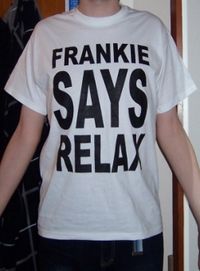
I used to have a white T-shirt with "Coca Cola" printed on it in Hebrew. I thought that was pretty cool. I wonder what happened to that shirt. I have a T with the names of all of the participants in my kibbutz-ulpan program from about 11 years ago. Now there's a good example of a T-shirt that only I (and a limited number of others) will understand.

I took this picture from Wikipedia's page about t-shirts. It is a classic example of a bold design that means nothing to anybody. Who is Frankie and why does he say to relax? Am I supposed to go up to the wearer and ask him? If Frankie said to jump off a cliff, should I print that on my T-shirt as well? And it's not just that Frankie says relax, it's that Frankie SAYS relax. Is that different to FRANKIE says relax or Frankie says RELAX? What is the hidden meaning behind "SAYS" in larger font? One could really get a headache thinking about this.

I liked the concept of the heat-sensitive T-shirts that were in vogue years ago (Global Hypercolor). The T-shirt would change colour in the areas where your body gave off heat. This is great if you want everyone to know that right now your armpits are rather warm.

Most T-shirt designs don't seem to make any sense whatsoever. Often, they include a word or a design that only the wearer of the T-shirt understands. Everyone else just thinks you are strange. Perhaps the T-shirt designer just opened a dictionary, picked a long word and stuck it on to the front of the T. It doesn't actually take much effort, except that you have to know how to read.

Tuesday, June 20, 2006

Motivation

What motivates you to do whatever it is that you have to do? I'm no psychologist, but I reckon that what motivation boils down to - and this really is the driving force behind any sort of motivation - is reward and punishment. Achievement = Reward; failure = punishment. It's a pretty simplistic perspective, but I think that it is true. Here's what I mean:

I know that when the rubbish bin gets full, the [thought of the] smell of the overflowing rubbish is enough to get me to remove it from the house. When I know that we are expecting company, I am very motivated to put a bit more elbow-grease into scrubbing the floor-tiles. When I have a project due at work by a particular deadline, the thought of not getting it done on time is a good motivator.

Sometimes you set yourself rewards: if I get this done, then I'll reward myself with a rest/fun activity/bag of peanuts/stiff drink. It takes a bit of self-control not to give yourself the reward before you actually complete the task. For example, it is not a good idea to take that stiff drink just before you mow the lawn. Your prize azaleas might not be so understanding.

Kids, however, are motivated differently. They don't understand the true consequences of not getting something done on time or not doing something properly - so you have to invent consequences that they can comprehend. For example, we are (still) in the middle of renovations. The kids love to play in the piles of sand that the builders have left outside. They take out their toy cars and trucks and build roads and bridges. It keeps them occupied for hours. But they don't realise that if they leave all their toys outside, the builder might just scoop them up and make them a permanent part of the foundation. Their motivation to clear away the toys starts and ends with, "If you don't clean up your toys, you are not getting an icy-pole" (or, "If you clean up your toys I'll give you each an icy-pole"). There you go. Food. Something they can relate to. Very simple.

What about us adults? When you have something that needs to be done, what is the motivation for doing it well? Is the motivation that your boss will say, "Good job!" Is the motivation that you won't fail in completing that task? No the motivation is exactly the same as the kids', "If you do a good job you will get a bonus/not get fired". There you go. Money. Something we can relate to. Very simple.

My motivation for writing this blog entry is that this is my 50th post and I wanted to get at least this far. Unfortunately, there is no money involved. Maybe I'll help myself to an icy-pole...

Monday, June 12, 2006

Jackpot! You've won the lottery!

What would you do with a million dollars if it suddenly came your way?

When you come to think about it, a million dollars isn't all that much. Once you go on a round-the-world first-class trip and then buy your new house and car, there really isn't much left. Should you just quit your job and then live a decent, but easy life? Will a million dollars be enough to retire on?

All good questions.

Okay. Now, let's say you won a million dollars in the lottery and a couple of weeks later the lottery jackpots to, say, $5m or $10m - would you be tempted to play again? What are the odds that you would win twice? What would it take for you to play again - a large jackpot, or perhaps you would play again anyway (at least now you can afford to!)

Now, let's say that you entered the lottery and you won $300m. Could you ever be the same person again? How would it change your life? Would you still work "just for the fun of it"? Would you spend your time on a private cruise ship somewhere in the Carribean? Would you throw yourself into charity work for the poor and unfortunate?

Here are some post-lottery-winning tips from http://www.lotterypost.com/news-97404.htm:
  • Keep that ticket safe.
  • Think about your job.
  • Find people you can trust.
  • Decide on a lump sum or payments.
  • Arrange for a special account at the bank.
  • Change your phone number.
If you are so inclined, you can read here about 8 people who won and then lost their millions. This includes a story about a woman who won the same lottery twice, to a total of $5.4m.

On the other hand, here is a video of an Aussie who bought a scratchie ticket and won a car: http://www.dailymotion.com/tag/lottery/video/90280. For those of you who can view the video, skip the next paragraph.

This guy had won a car and was asked by a TV station to recreate the scene, so they film him going into a newsagent to buy another scratchie ticket. He wins $250,000! He turns to the camera and in a really bewildered voice he says, "I've just won 250,000. I'm not joking. I've just won 250,000." Then he turns away from the camera and starts crying in a not very blokey sort of way. What, I'm supposed to feel sorry for the guy?

Here are some statistics of what lottery winners do with their money (from: http://www.lotterybuddy.com/jackpot.htm). This is taken from a sample of more than 240 lottery winners who won at least $1m each.
  • 89% put money in the bank.
  • 75% shared money with family or friends.
  • 62% bought a new car.
  • 58% paid off debts.
  • 56% took a vacation.
  • 47% donated to charity.
  • 37% paid off mortgage.
  • 34% bought a house.
  • 28% paid for education for self/family.
  • 15% changed their overall lifestyle.
  • 6% bought a boat.
Surprisingly, none of them stay home to write blogs all day. Curious.

Sunday, June 11, 2006

Con Men

Okay, I admit it. I am intrigued by stories about con men and how they trick people into parting with their money. I don't know why. I know it's wrong to swindle someone, but for some reason I find the whole subject fascinating.

According to Wikipedia, the term "Confidence Man" came about because of a certain individual by the name of William Thompson.

William Thompson was an American criminal whose deceptions caused the term "confidence man" to be coined.

Operating in New York City in the late 1840s, genteelly-dressed Thompson would approach an upper-class mark and begin a brief conversation. After initially gaining the mark's trust, Thompson would ask "Have you confidence in me to trust me with your watch until tomorrow?". On taking the watch (or, occasionally, money), Thompson would depart, never to be seen again.

Thompson was arrested and brought to trial in 1849, in a case that made newspaper headlines across the country. The New York Herald, recalling his explicit appeals to the victim's "confidence," dubbed him the "confidence man," the first known use of the term.

To humour myself, I've found a few more stories about some of the great con-men of days-gone-by. I thought I'd share them with you, my virtual-fellow-would-be-tricksters:

Joseph "Yellow Kid" Weil (1875-1976)
Firstly, look at this guy's life-span. Crime certainly does pay - at least the medical bills, so it seems...

Here's one of his scams gleaned from: http://home.netcom.com/~mikalm/weil.htm

Hearing that the Merchants National Bank in Muncie, Indiana had moved into a new building, he made arrangements to rent the old building, with all its fixtures and furnishings intact, for one week.

The Yellow Kid then sent his stooges over to the bank's new location. They brought back deposit slips, counter checks, withdrawal slips, and other forms imprinted with the Merchants National Bank name and logo. Other associates got hold of money bags, and filled them nine-tenths full with slugs, being careful to put real coins at the top. They also assembled stacks of "boodle": hundreds of singles or even blank papers sandwiched by big-denomination bills. Still more confederates rebuilt the bank's interior right down to the smallest detail.

Now that the bank had furnishings and assets, it needed people. Weil supplied them in short order: his grifter buddies were hired to play tellers, guards, and male patrons; the women from a local bordello took the roles of female employees and account holders. Not missing a trick, he paid uniformed streetcar conductors to pose as messengers.

When Weil led his mark-a stock investor-into the building on the big day, the effect was perfect. Like the suckers who had followed Weil into his phony betting parlors in Chicago, the gullible investor saw exactly what the Yellow Kid wanted him to see: a prosperous, thriving bank clogged with customers, where scurrying tellers hauled piles of greenbacks and sacks of coin back and forth and messengers dashed in and out with important documents. The mark witnessed this incredible display for an hour, met with the president, and handed over $50,000 on the spot, confident that he would soon see handsome profits. Of course, he never saw the money again; upon his departure, the Yellow Kid Weil branch of the Merchants National Bank vanished, like Brigadoon, into thin air.

Victor Lustig - The man who sold the Eiffel Tower.
From http://en.wikipedia.org/wiki/Victor_Lustig.

In 1925, France had recovered from World War I, and Paris was booming. Expatriates from all over the world went there to enjoy being at the leading edge of the latest trends. It was flashy, fast moving, and an excellent environment for a con artist.

Lustig's master con began one spring day when he was reading a newspaper. An article discussed the problems the city was having maintaining the Eiffel Tower. Even keeping it painted was an expensive chore, and the tower was becoming somewhat run down.

Lustig saw a story behind this article. Maybe the city would decide the Eiffel Tower was not worth saving any longer. Lustig outlined the possibilities and developed them into a remarkable scheme.

Lustig adopted the persona of a government official, and had a forger produce fake government stationery for him. Lustig then sent six scrap metal dealers an invitation to attend a confidential meeting at the Hotel de Crillon on Place de la Concorde to discuss a possible business deal. The Hotel Crillon, one of the most prestigious of the old Paris hotels, was a meeting place for diplomats and a perfect cover. All six scrap dealers replied and came to the meeting.

There, Lustig introduced himself as the deputy director-general of the Ministry of Posts and Telegraphs. He explained that the dealers had been selected on the basis of their good reputations as honest businessmen, and then dropped his bombshell.

Lustig told the group that the upkeep on the Eiffel Tower was so outrageous that the city could not maintain it any longer, and wanted to sell it for scrap. Due to the certain public outcry, he went on, the matter was to be kept secret until all the details were thought out. Lustig said that he had been given the responsibility to select the dealer to carry out the task.

The idea was not as implausible in 1925 as it would be today. The Eiffel Tower had been built for the 1889 Paris Exposition, and was not intended to be permanent. It was to have been taken down in 1909 and moved somewhere else. It did not fit with the city's other great monuments like the Gothic cathedrals or the Arc de Triomphe, and in any case at the time it really was in poor condition.

Lustig took the men to the tower in a rented limousine to give them an inspection tour. The tower was made of 15,000 prefabricated parts, many of which were highly ornamental, and Lustig showed it off to the men. This encouraged their enthusiasm, and it also gave Lustig an idea who was the most enthusiastic and gullible. He knew how to be attentive and agreeable, and let people talk until they told him everything he wanted to know.

Back on the ground, Lustig asked for bids to be submitted the next day, and reminded them that the matter was a state secret. In reality, Lustig already knew he would accept the bid from one dealer, Andre Poisson. Poisson was insecure, feeling he was not in the inner circles of the Parisian business community, and thought that obtaining the Eiffel Tower deal would put him in the big league. Lustig had quickly sensed Poisson's eagerness.

However, Lustig knew he was walking over dangerous ground. Fraud was bad enough, but the authorities would be very displeased at his having put over the fraud while impersonating a high government official. And Poisson's wife was suspicious. Who was this official, why was everything so secret, and why was everything being done so quickly?

To deal with the suspicious Poisson, Lustig arranged another meeting, and then "confessed". As a government minister, Lustig said, he did not make enough money to pursue the lifestyle he enjoyed, and needed to find ways to supplement his income. This meant that his dealings needed a certain discretion.

Poisson understood immediately. He was dealing with another corrupt government official who wanted a bribe. That put Poisson's mind at rest immediately, since he was familiar with the type and had no problems dealing with such people.

So Lustig not only received the funds for the Eiffel Tower, he also got a bribe on top of that. Lustig and his personal secretary, an American conman named Dan Collins, hastily took a train for Vienna with a suitcase full of cash. He knew the instant that Poisson called the government ministries to ask for further information that the whole fraud would be revealed and the law would intervene.

Nothing happened. Poisson was too humiliated to complain to the police. A month later, Lustig returned to Paris, selected six more scrap dealers, and tried to sell the Tower once more. This time, the mark went to the police before Lustig managed to close the deal, but Lustig and Collins still managed to evade arrest.

To finish off, here is a short one about Arthur Ferguson (1800s - 1938) from http://www.yotor.com/wiki/en/ar/Arthur%20Ferguson.htm.

Arthur Ferguson was a Scottish con artist. In the 1920s, Ferguson found out that he could obtain a tidy profit by selling Americans visiting London such items as Nelson's Column in Trafalgar Square (for the sum of 6,000 pounds), Big Ben (1,000 pounds for a down payment), and Buckingham Palace (2,000 pounds for a down payment).

It finally dawned on Ferguson that America was indeed the land of opportunity, and so he emigrated there in 1925. He sold the White House to a rancher on the installment plan for yearly payments of $100,000 USD, and tried to sell the Statue of Liberty to a visiting Australian, who went to the police. The authorities had been looking for the mysterious salesman of public landmarks, and Ferguson went to jail, to be released in 1930. He profitably continued his trade in Los Angeles until his death in 1938.

Wow.

You know, since you have been so wonderful reading to the end of this blog, I'm going to make you a genuine offer. I have the original one-of-a-kind diamond tiara Pricess Dianna wore for her wedding to Prince Charles. I'll offer it to you for a special price. But wait, I'll give you a discount if you buy in bulk...

Thursday, June 08, 2006

How To Lose Your Money

There are all sorts of easy ways to lose your money. Casinos spring to mind as the most obvious method. Let's see...then there are horse races and any form of lotto.

But in this day and age, there are many more creative ways to lose your hard-earned cash. For example, you could set up a business deal with a Nigerian, or you can enter your PIN on a scam banking internet site. There are now many wonderful ways to lighten your wallet. But those are so impersonal. I mean, you never meet the trickster behind the scam and they really lack the personal touch. Take a look at this guy, Frank Abagnale (if that is his real name). He masqueraded for years as a pilot, a doctor and a professor. Now there is a guy who isn't afraid to put his face to his work. Okay, admittedly he was on the run for many years for defrauding banks and whatnot. He ended up doing prison time. But that's not the point. The point is that now he is now a best-selling author and runs a financial fraud consultancy. He's a celebrity and a businessman!

There was once an episode of Cheers where Woody gets swindled out of some money when trying to give a guy change for $10. The swindler made it so complicated that Woody couldn't keep up and he ended up forking out far more than change for $10. What the swindler was saying sounded right, but somehow the math didn't add up.

I found this example of a similar type of con on the internet:

A woman goes into a jewellers' shop and buys a gold ring for £100 (which she pays for in crisp, £20 notes). As she is leaving the shop, she pauses, and then goes back to the counter. I've decided I don't want this £100 ring - I want that £200 ring instead, she says. The jeweller takes back the £100 ring and gives her the £200 one. That will be another £100 then, madam. At which point the customer stamps her foot and says: I don't owe you anything. Earlier on I gave you £100 in cash for the ring. And now I've just handed over the ring as well, which is worth £100. So I've given you £200, and you have given me a £200 ring in return, so we are quits. And with that, she walks out of the shop, leaving the jeweller scratching his head.

There is something romantic about a good con. In fact, there are a number of books about the "great con-men of the past". Why? Because even though what they are doing is tantamount to stealing, cheating, lying and fernangleling their way into your pocket, they are doing it with style and finnesse. How admirable.

Monday, June 05, 2006

Word Games

When I was a kid, we played many types of word games (I-Spy, Name a Country Starting With the Last Letter of the Country I Just Mentioned and so on). And then there were the word games, where you try to trick the other person into saying something that doesn't make any sense. For instance, get the other person to say "milk" ten times quickly and then ask them what a cow eats. Or, get them to say "go" ten times quickly and then ask them what you do when you come to a red light. Or get them to say "toast" ten times quickly and then ask them what you put in a toaster. You get the picture.

My kids recently discovered the joy of word games. Simple ones, but [for them] fun. Like saying a word really fast and then slurring it into itself to create a new word. Try saying "horse" really, really fast - it will end up sounding like "sauce". Or, for a variation, try saying "car" extremely fast. You will soon gag on your own word. How entertaining.

Here's an amusing word excercise for the more bored of you out there:

Think of a word, any word - better if it has more than one syllable. For those of you who are having trouble deciding what word to choose, "freely" works well for this excercise. Now, say the word out loud. Think of its meaning. Spell out the letters of this word.

Now that your word is firmly in your mind, say it again. But this time, say it over and over again. Repeat the word without modulating your voice. Just say it again and again and again as many times as you feel necessary.

As you repeat the word, concentrate on your own voice. After a while you will find that the word begins to sound absurd. The combination of letters and the sounds they produce seem ridiculous.

My favourite is the word "people", which I find absolutely fascinating. People. People. People. People. People. People. Outrageous, isn't it?